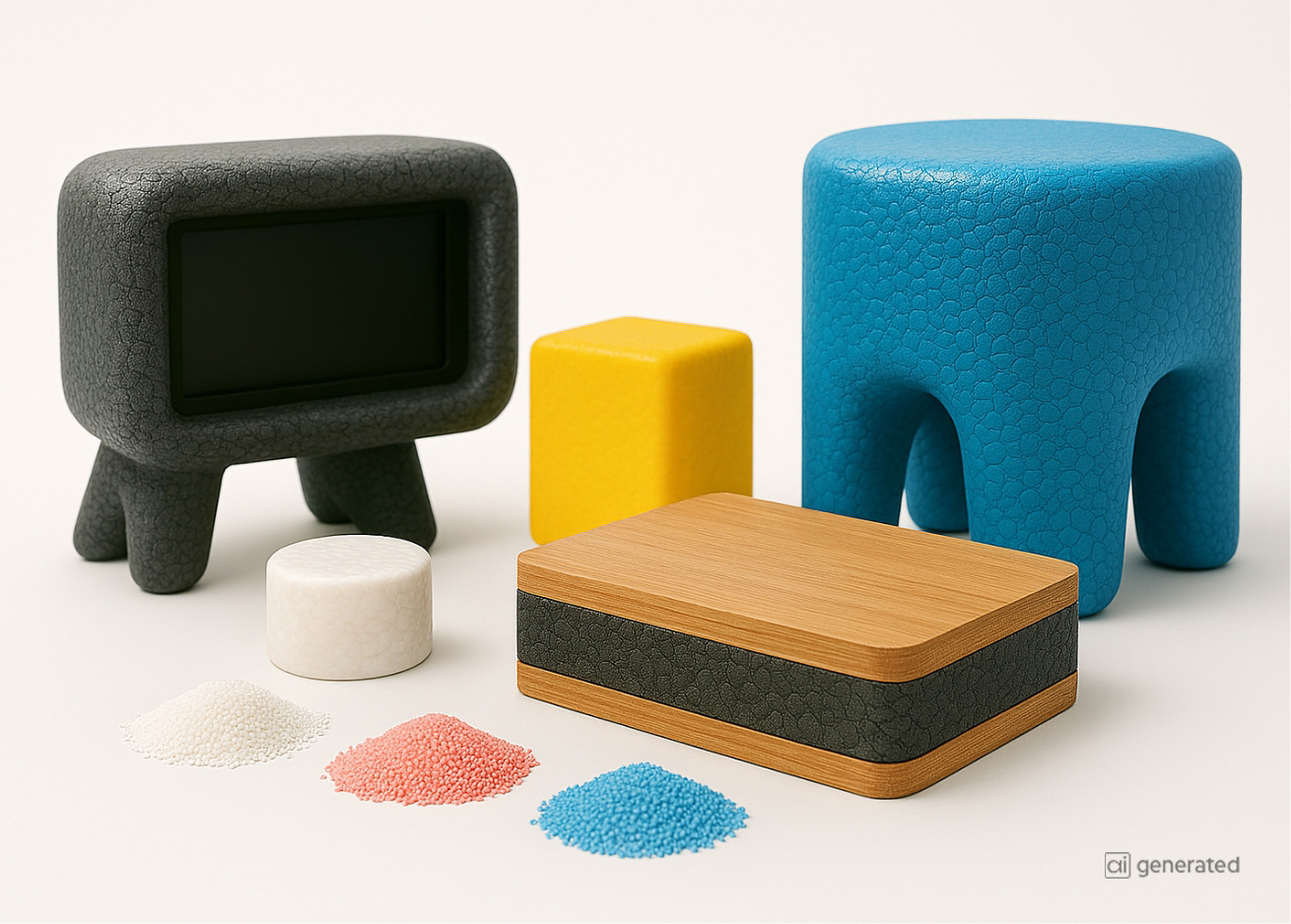


Transforming Particles into Performance

Particle foams are produced from plastic granules in the form of small beads. Two basic types can be distinguished:

  • Expanded particle foams (e.g. EPP) are supplied in the form of pre-expanded foam beads and can be processed directly into moulded parts or be pre-expanded a second time at the processors.
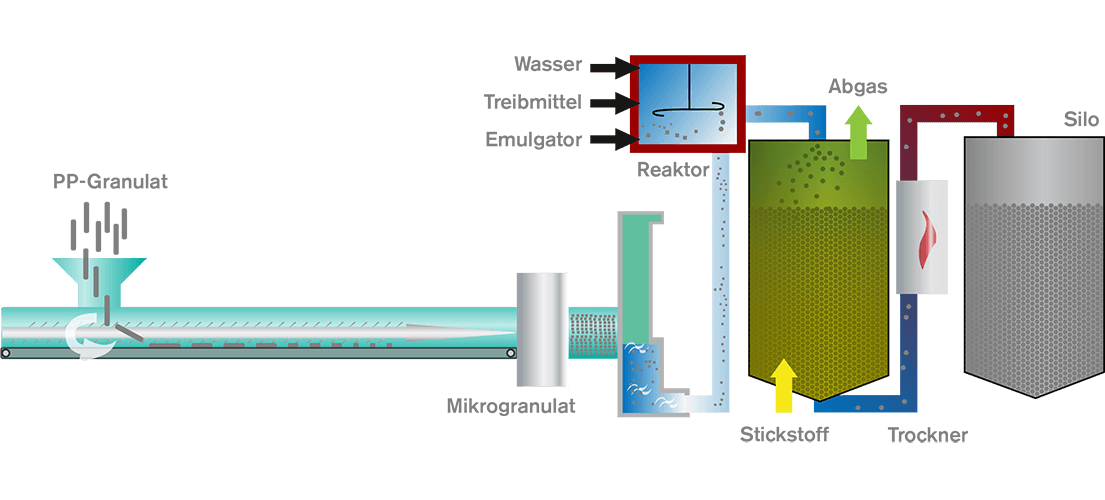
  • Expanded particle foams (e.g. EPS) are delivered as compact microgranules containing a blowing agent (e.g. pentane or CO) and are pre-expanded to the desired density only shortly before moulded part production.

In the moulding process, the individual foam beads are bonded together in the mould to form stable, lightweight and functional components. In addition to the established steam-based moulding, there are also modern steam-free moulding technologies that are particularly interesting for high-performance particle foams with very high softening temperatures and for water sensitive materials.
Particle Foam Processing

From Granule to Individual Particle Foam Beads

In autoclave foaming, compact polymer particles are exposed to blowing agents such as CO₂ in a pressure vessel. At elevated temperatures and pressures, the blowing agent diffuses into the polymer until thermodynamic equilibrium is reached. A subsequent rapid and controlled depressurisation causes the blowing agent to expand abruptly inside the softened polymer granules, resulting in the formation of a closed-cell structure.

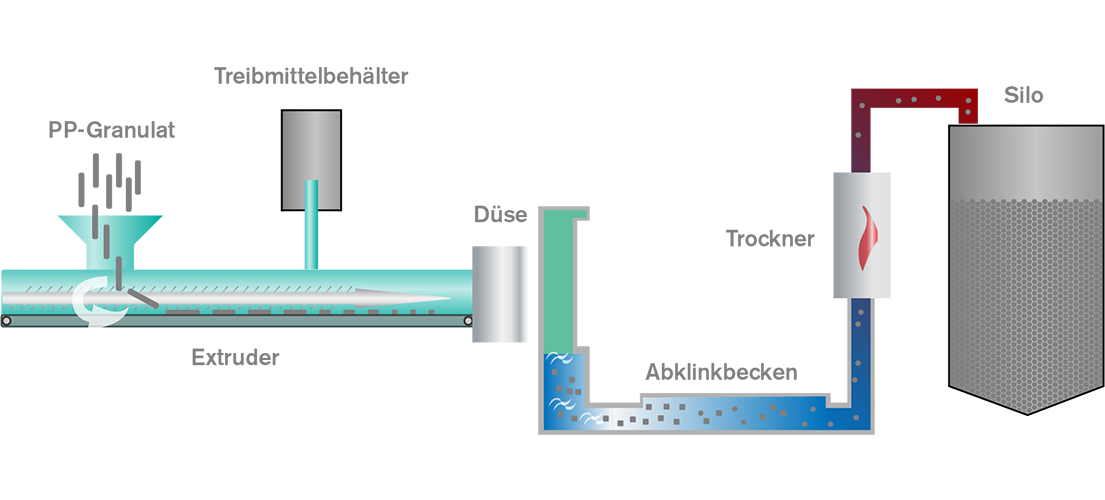
Another manufacturing route is the foam extrusion of particle foams. In this process, the polymer is melted in an extruder and the blowing agent is injected into the polymer melt under pressure to achieve a homogeneous distribution. The melt containing the blowing agent is then continuously extruded through a die. Upon exiting the die, the pressure drops instantaneously, causing the blowing agent to expand and the melt to foam. By appropriately designing the die as well as employing suitable cutting and separation techniques, various particle shapes can be produced. Depending on the process conditions, this method allows for the production of both pre-foamed beads and blowing-agent-loaded granulates.

Prefoaming

During pre-foaming, expandable particle foams such as EPS are converted from their compact initial form into lightweight foam beads. The required energy input is provided either by steam or radiation.

In the conventional steam-based pre-foaming process, blowing-agent-loaded polymer particles are exposed to saturated steam at temperatures above the polymer’s glass transition temperature. As a result, the polymer softens and the blowing agent contained within the material evaporates. The increasing internal pressure of the particles leads to volumetric expansion. Immediately after pre-foaming, the foam beads are stabilised in a fluidised bed.

In the radiation-based pre-foaming process, the expandable particles are metered onto a conveyor belt. The energy input is provided by infrared (IR) radiation. A key advantage of this method is that the material is not exposed to moisture, making it particularly suitable for moisture-sensitive particle foams. In addition, higher process temperatures can be achieved with radiation-based heating, enabling the processing of high-performance particle foams with elevated softening temperatures.

Molded Part Production

From Individual Particle Foam Beads to Component

In the moulding process, the individual beads are welded together to form a dimensionally stable component.

Steam-based Moulding

The conventional technology is steam-based moulding. In this process, the mould is first closed and then filled with loose particle foam beads. The particles inside the mould are then heated by steam, causing the surfaces of the individual particles to soften and bond together into a solid component. In the subsequent process step, the component must be stabilised to ensure the required dimensional accuracy and shape stability. Finally, the mould can be opened and the finished component removed.

You are currently viewing a placeholder content from Vimeo. To access the actual content, click the button below. Please note that doing so will share data with third-party providers.

More Information

Steam-less Moulding

In addition to the conventional steam-based process, modern steam-free moulding technologies have been developed, which are particularly attractive for high-performance particle foams with very high softening temperatures as well as for moisture-sensitive materials:

In radio-wave-based moulding, energy is introduced directly into the particles via electromagnetic fields, causing them to be heated from the inside. This can result in very short cycle times and reduced energy consumption.

Another variant is dry variothermal moulding, in which only the mould is heated to high temperatures and subsequently cooled again. In this process, the particle bed inside the mould is heated exclusively by heat conduction from the mould walls into the particle bed. In this way, sensitive components, such as electronic devices, can be directly integrated into the particle foam.

An additional process combines coated particles with a variothermal process to enable bonding without the use of steam and at lower temperatures. This makes it possible to reliably manufacture even demanding hybrid components, such as metal face sheets on particle foam.

You are currently viewing a placeholder content from Vimeo. To access the actual content, click the button below. Please note that doing so will share data with third-party providers.

More Information

Application Areas

Foam in All Its Diversity

Particle foam is used in a wide range of areas, from lightweight and energy-absorbing components in automotive, to protective packaging and technical components for electronics and sports equipment.
All Areas of Application